








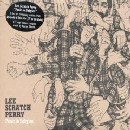
Lee "Scratch" Perry
From the Black Ark to the Skull Cave,
the Madman Becomes a Psychiatrist
First Appeared in The Music Box, December 2006, Volume 13, #12
Written by Douglas Heselgrave

If his recent musical output is any indication, Lee "Scratch" Perry, the eccentric senior statesman of dub reggae, clearly is on a roll. At 71 years of age, a time when most artists are well into what Tom Waits calls "the tribute stage," Perry has resurfaced to produce some of the finest music of his already legendary career. Currently, he is on the road performing concerts that would be the envy of most significantly younger musicians.
Perry, of course, was the legendary Jamaican producer who was responsible for helping Bob Marley develop his style, and he recorded many of Marley’s early singles as well as hundreds of other reggae hits. Nevertheless, he has not had an easy ride on this Earth. Like many great artists, he has suffered from theft, misunderstanding, and accusations of mental instability. Some of these have been well founded, while others have arisen from a failure to grasp both his artistic process and his final output.
During his heyday in the 1970s, after serving an apprenticeship with the pioneering reggae producers Clement "Coxsone" Dodd and Joe Gibbs, Perry built and worked out of his own legendary Black Ark studio in Kingston, Jamaica. There, he produced and recorded music with artists such as the The Congos, The Gladiators, The Heptones, Junior Murvin, and The Upsetters. In most instances, he extracted from them the best music of their careers. Perry’s unorthodox recording style, which evolved at this time, still forms the bedrock of his musical legend. With a work ethic and a creatively adventurous spirit that is unsurpassed in popular music, Perry completely transformed people’s ideas of what a reggae song could be. At the Black Ark, he did his groundbreaking work by using technology that was hopelessly cheap and completely unsuited to the task at hand, even by the standards of the day. He recorded his music on low-budget, eight-track decks, by piling layers upon layers of instrumentation until he achieved the sounds that he heard in his mind. "It was only four tracks on the machine," Perry famously explained, "but I was picking up twenty from the extraterrestrial squad."
Neither The Beatles nor Pink Floyd, despite their comparatively huge budgets and resources, holds a candle to Perry in terms of creatively incorporating "found" sounds into the flow of a song. In his attempt to obtain just the right effects, everything from toys to power tools have been featured in his work. During one famous session for The Congos’ The Heart of The Congos album, Perry wired a rake for sound and used the results of his frenzied gardening as a backing rhythm for a track. At another session, he buried a musician’s television in his backyard to prevent interference from what he termed "ungodly influences." When the musician complained, Perry told him to listen more closely and to play what the TV was broadcasting from under the ground. To him, everything is music for the person whose ears are properly attuned.
Working with his mixing board as his palette, Perry produced an average of a song a day, creating music at a dizzying pace with little sleep or time for anything else. He kept up this lifestyle for years on end, but as the ’70s concluded, cracks were beginning to appear in the atmosphere at the Black Ark. It’s impossible to determine whether it was lack of food and rest, overindulgence in marijuana and alcohol, or "evil spirits" that lead to Perry’s spiral into madness and his decision in April 1983 to burn down his studio. By Perry’s own account, "I did make a dread studio, and I said I’d make a righteous studio and a Godly studio. It was even too dread for me. I had to burn it down to get rid of that dread vibration. I forgot that I was a soul man. It was a dreadful equation. Too dreadful for me."
A protracted period of legal and creative difficulties as well as mental instability followed the demise of the Black Ark. Perry’s solution was to go into exile, initially in England, where he did some recording with The Clash and other British musicians, and then to Switzerland, where, he explains, "[I had] to hide in the mountains and rinse the dread off of my head. I had to isolate myself in the ice and build myself an igloo."
Unfortunately, Perry’s hiatus did nothing to end his escalating difficulties. His unstable behavior led to his being unable to get the visas that would allow him to tour in North America — a situation which only recently was resolved. Furthermore, his absence from Jamaica led his former wife to sell and release many of his inferior and unfinished master tapes, many of which continue to be recycled on the market today. In the middle-to-late 1980s, newly married and living in Switzerland, Perry resurfaced to record three albums with British producer and musician Adrian Sherwood. One of their collaborations was From the Secret Laboratory, which stands amongst his greatest works and should have marked the beginning of a second important career phase for Perry. Unfortunately, he and Sherwood had a falling out, and he subsequently languished in relative obscurity until he began recording and touring regularly with the Mad Professor during latter portion of the ’90s.
At this point, like a Phoenix improbably rising again, it seemed like Perry was ready to reinvigorate his career. Despite some excellent concerts in 1998 and 1999, the audiences who came to see Perry primarily were celebrating the fact that they were witnessing a legend who was performing in the flesh more than they were listening critically to his musical performance. Indeed, the recorded output originating from this time — mostly with the Mad Professor — was spotty, and subsequent tours in 2000 and 2001 were mostly embarrassing because Perry haphazardly was delivering a series of underdeveloped musical concepts. While some rationalized his appearances as being a post-modern interpretation of a rock concert, in truth, Perry often would go on stage and smoke joint after joint, rambling incoherently as the Mad Professor desperately offered a variety of rhythms for him to use. The nadir of this phase in Perry’s musical journey was seen at a concert in Vancouver early in 2001, where it appeared that he didn’t want to play anything resembling a complete song. Instead, he stood center stage smoking himself into oblivion as his wife joined him to chat with the Mad Professor as they drank champagne together. At this time, even Perry’s most ardent fans began to write him off.
What a magnificent surprise, then, to hear Perry’s latest outing Panic in Babylon and to attend the latest incarnation of his live show. Touring with Dub Is a Weapon, a superb band from Brooklyn, Perry once again is on fire, and he is playing with a ferocity that has to be seen in order to be believed. Appearing on stage in a uniform that defies description and waving a skull cane for which Screaming Jay Hawkins would have traded his mother, Perry’s concert was easily the most infectious and creative musical attack to hit any stage this season. Running, jumping, skipping, gesticulating, and rhyming off the top of his head, Perry turned the performance into a weird, voodoo, vaudeville, snake oil show — like Tom Waits propositioning Nina Hagen to the strains of a Coltrane serenade. Perry left the audience feeling weird, jumpy, uncomfortable, and thoroughly satisfied, and he played with the commitment and soul that is usually reserved for performers on their way up — not when they’re well past retirement age.
Catching up with Perry after his recent show in Vancouver, he concurred that he’s feeling better about music and life than he ever has. He attributes a lot of this to deciding, at age 70, to quit smoking marijuana and drinking alcohol. "Well, I discovered that smoking makes you lose your mind and that smoking can make you get unconscious. It can make you think and do things that are not normal just to get high. They can make you think things that are not real, " he explained.
It is fascinating to ponder what a man who talks with aliens and who confides his secrets to a plastic skull would consider not real. Anticipating this, he added, "Well, if you want to see the things that are real, you’ve got to love yourself. You’ve got to preserve yourself." Indeed, he gives the impression of a man who has come from the other end of a long period of darkness, and instead of singing his celebrated line "I am a madman" in concert, he sings a new song "I am a psychiatrist" to confirm that he now is in control.
Perry admitted that, even though it was his doctor who told him to quit smoking for his health, it was his persistent wondering about the voices inside his head that made him stop. He wanted to find out if, as he explains, "it was the smoke making the music or Lee Perry making the music. I found out it was me and that I don’t need to smoke."
Perry now sees his indulgence in drugs and alcohol as the stage of his journey where he lacked the confidence to recognize himself. Using his typical metaphorical speaking style, he stated that his smoking days harkened back to the moment when he was a person. "When we did those things, we were part of the human being. But, I lost my identification and did not know who I [was]. So, I was playing the part of the human being who smokes." Tapping his skull cane, he continued, "But then came the phantom from the cave and the phantom rebel. He wanted no more of that, so that is why the Ark burned down."
To further explain his relationship with his music, he compared it to the bond between a father and a child — a child he feels he has rejected in recent years. "My music is a child. [It] is a baby. God makes man, and man makes music. So, when man makes music, he must depend on what is in the music. Man becomes the scientist, and what he mixes with the music is what he gives to the people. I used to mix my music with herb — smoking herbs and drinking wine and white rum and cigarettes."
At this point, Perry began to hold forth on his latest impressions of the meaning of life and the nature of the messages God provides to man. It is these infamously reported utterings on the spiritual nature of truth that demonstrate why he has alienated many of his original, conservative Jamaican and Rastafarian fans. Steeped in scatological imagery, Perry believes that bodily processes and fluids are the proof of God and that they are the sacrament — not marijuana or any other substance. As he testified, both on and off stage, "Now I mix my music with piss, and mix it natural with pooh. The way my bass player plays sometimes, he squats and gives sound like ‘pooohhhhhh!’ The mess of creation! My God is the God of nature and the God I respect. When I’m thirsty, he gives me water and when I drink, the water stays for a few days until it’s not normal water anymore. It becomes piss water. So, I give thanks to God to give me water to drink and to clear my passage so that I can piss. When I was hungry, he gave me food and, later that day, the food became shit. So I say, ‘thank you today for the food that becomes shit tomorrow.’ I give praises that I can give a shit and not suffer from constipation." And constipation, whether physical or creative, he inferred with a twinkle in his eye, not only is the enemy of all artistry, but it also often is a prelude to death.
This seemed like a natural time to ask Perry why he has started bringing a staff topped with a skull on stage with him. He carefully explained that the skull is not so much a symbol of the transience of life as it is a reminder that we are all responsible for our destinies and that all of our actions are created by us, inside of ourselves. Poking his fingers up the skull’s nose and through its eyes, he explained, "Everything that is my skull is in my skull cave. That’s where my law and order comes from. That’s where the phantoms come from — the skull cave. So, if we don’t take care of the skull, it is the cave...the door to the cave…see my skull rejects smoking."
But, his skull does not reject fire, he explained, because fire is an elemental symbol. The smoke and fire that once came from his spliff, now comes from candles placed around the stage and incense sticks that he lodges in his hat. "The candle to me and the fire to me represent purity," he stated. "The flame is gold, so if you look at it, it’s the color of the sun. So, when we hold a flame out there, it’s a lion that I’m holding up in the sky. The golden lion is the sun."
Perry, then, elaborated upon his theory about how difficult it is for black people to find God because, he believes, their color represents an obstacle to bathing in the salvation of white light. "So, white represents purity that means that even though I am black, I am pure inside," he explained. "I am white inside that is why I have so many white fans that know me. I discover that my spirit is white and when I talk to the white fans they understand me very well. I’ve been talking to them for thousands of millions of years, and what I tell them to do, they do."
Perry grinned widely as he said this, suggesting that some of what he says must be taken with a grain of salt. Like Bob Dylan in his infamous press conferences of 1966, Perry looks at all forms of media interaction as being an opportunity for performance and for challenging his audience. As a further provocation he offered, "It’s not a surprise to me that black people cannot accept me because it was written by God himself. God said that his own people, the black people, don’t accept God. They say he doesn’t exist. A good man is never recognized in his own country." Clearly, Perry has no interest in being politically correct or easy to nail down.
As our session of verbal jousting drew to a close, Perry’s crazy persona relaxed and gave way to allow a shy man and a gifted artist, one who at once loves and shuns the marketplace, to emerge. At this stage of his life, delivered from the demons and disappointments of his past, Perry appears grateful to be exactly where he is. "Ask and you shall receive. And I asked for and have received so much," he said.
Before our discussion ended, I asked Perry why he still records and tours, and he revealed playfully, "It’s just like this interview. It’s all a lot of work." He winked, smiled, and added, "but in truth I enjoy it." He clasped my hands warmly to emphasize this point before carefully packing his skull cane away, as lovingly as any father ever tucked a child into bed. As he did so, he said to the image of death and to me, "Until the next time when I hope we can do this again." I can’t speak for the bones in his duffle bag, but for myself, I can’t wait.
Panic in Babylon is available from
Barnes & Noble. To order, Click Here!
Copyright © 2006 The Music Box