








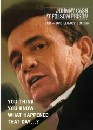
Johnny Cash
At Folsom Prison
[Legacy Edition]
(Columbia/Legacy)
First Appeared in The Music Box, October 2008, Volume 15, #10
Written by John Metzger
Mon October 27, 2008, 06:30 AM CDT

There has always been more to Johnny Cash’s seminal concert recording At Folsom Prison than his performance. With the passage of time, though, the collection’s full meaning inevitably has slipped further and further from view. Despite several attempts to revitalize the collection by reissuing it with previously unreleased material, none of its incarnations have come as close to capturing the complete aura of the event as the two-disc, one-DVD package At Folsom Prison: Legacy Edition. There is no doubt that its companion At San Quentin is an equally sterling endeavor, one that is stuffed full of the same levels of empathy and rebellion. At Folsom Prison, however, will always be the crowning achievement in Cash’s canon, if only because its intangible moments of happenstance had such transformative effects on The Man in Black’s life and career.
Cash had performed for prisoners before — including concerts held at the incarceration unit in Folsom, California. Therefore, by the time that he finally had gained approval to record an album there, he clearly had determined what would and wouldn’t work for his audience. Utilizing the same basic set list for each of the two shows that he delivered on January 13, 1968, Cash strung together a thematic suite of cautionary tales and sympathetic odes that touched upon heartache, loss, and loneliness as well as spiritual salvation and what life was like behind prison walls. He understood, for example, the uncomfortably dark humor in Shel Silverstein’s 25 Minutes to Go, though his rendition also captured the horror of the hangman’s noose that had executed 93 of the correctional facility’s inmates. Elsewhere, tunes like I Still Miss Someone and Send a Picture of Mother spoke to their isolated existence outside mainstream society.
Cash’s appearance at Folsom Prison in 1968 was a turning point in his career. In effect, he leveraged his own predicament — his steady but nonetheless troubled relationship with June Carter, his declining record sales, and a string of concerts that were canceled when he failed to appear — in order to cultivate a connection with the downtrodden and largely forgotten members of the assembled audience. Cash had written Folsom Prison Blues years before he had performed at the jail. Some, including the musicians who had worked with him at the time, would say that he stole it outright, especially considering its close lyrical and melodic resemblances to Crescent City Blues. Regardless, there undeniably never was a better time for him to revisit the song. In retrospect, the process of creating At Folsom Prison did as much to help bring some light to the inmates’ lives as it did to save Cash from his own personal demons.
This point is heavily emphasized by the expansive completeness of At Folsom Prison: Legacy Edition. It helps, of course, that both of the sets that Cash — along with opening acts Carl Perkins and the Statler Brothers — delivered before the assembled crowd of inmates have been restored to their full lengths. Although the original outing had been culled primarily from Cash’s morning concert, it also had been edited to remove a lot of his stage banter. Admittedly, the second set is less appealing. Cash had given so much of himself to the first show of the day that he simply ran out of steam. The material is delivered solidly and professionally, but overall, it just doesn’t have the same aggressive charge.
Written by Michael Streissguth and based upon his four-year-old tome Johnny Cash at Folsom Prison: The Making of a Masterpiece, the 85-minute documentary that accompanies At Folsom Prison: Legacy Edition is what ultimately gives the boxed set its illuminating heartbeat. Naturally, the film not only presents Cash’s background, but it also explains how he came to perform in such an unusual venue. Similarly, it establishes the tone perfectly by painting a portrait of the facility and how it was used to house prisoners who were so violent that they couldn’t remain at San Quentin.
The real story, however, that is told through At Folsom Prison: Legacy Edition, via both the music and the documentary, is one that revolves around perseverance and survival, sin and redemption, and the economic and social disparities of American life. It is a tale of how desperation can lead a person to walk down the wrong path and how the only hope for escaping from the abyss is to have a support network of people who care. Cash was lucky enough to have family and friends who could boost his confidence and build his self-esteem. Glen Sherley and Millard Dedmon, two inmates who saw him perform on January 13, 1968, weren’t so fortunate.
On the night before his appearance at Folsom State Prison, Cash was introduced to Greystone Chapel, a song that had been written by Sherley, one of the facility’s inmates. Without hesitation, Cash incorporated Sherley’s tune into his repertoire, unveiling it the following morning, near the end of his program. It immediately changed the lives of Sherley and Cash, and it gave both men a reason to carry on. For a time, it worked, too. With Cash’s backing, Sherley became a minor recording star, and he frequently appeared in concert as well as on the talk show circuit with The Man in Black. As heartfelt and pure as Cash’s intentions were, however, he was unable to fundamentally alter Sherley’s view of himself. Inevitably, Sherley’s past caught up with him, and to escape the ghosts that haunted his mind, he eventually took his life.
Taken along with the abundance of previously unreleased tracks, the
documentary — which was made specifically for inclusion on At Folsom Prison:
Legacy Edition — paints Cash in a more human light. It shows his strengths
as well as his weaknesses. In the end, by making Cash’s connection to the
inmates so palpable, the significance of the concerts as well as the subsequent
recording is fully restored. At Folsom Prison remains Cash’s masterpiece
because it so perfectly captured his mind, his heart, and his soul. 
Of Further Interest...
Bastard Sons of Johnny Cash - Distance Between
Johnny Cash - The Great Lost Performance
At Folsom Prison: Legacy Edition is available
from Barnes & Noble. To order, Click Here!
Ratings
1 Star: Pitiful
2 Stars: Listenable
3 Stars: Respectable
4 Stars: Excellent
5 Stars: Can't Live Without It!!
Copyright © 2008 The Music Box