








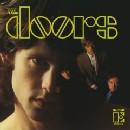

The Doors
The Doors
(Elektra/Rhino)
First Appeared in The Music Box, May 2007, Volume 14, #5
Written by John Metzger
Thu May 31, 2007, 06:00 AM CDT

Tweaking an album in preparation for its refurbished reintroduction to the marketplace certainly isn’t anything new, but what was done to the recently issued reworking of The Doors’ self-titled debut from 1967 is one of the most unforgivable acts imaginable. Neither the restoration of the music to its proper pitch, nor the inclusion of an array of previously excised backing vocals and piano and guitar accompaniments pose the biggest problems, either. The crux of the issue revolves around the inclusion of several phrases uttered by Jim Morrison that had been mixed out of the effort prior to its initial release. Granted, when the band’s record label opted to turn the directness of Break on Through (To the Other Side)’s "she gets high" into the more suggestive "she gets..." and when it chose to obliterate completely the tribal chant of "fuck, fuck, kill, kill, kill" that swirled through the climax to The End, it blatantly was censoring the outfit in order to improve its commercial viability. The Doors fully had intended for those statements to be included in its songs, and Morrison famously made the point that he didn't like being edited by singing Light My Fire on the Ed Sullivan Show precisely as it had been written.
Despite the fact that the suppression of Morrison’s voice and the alteration of his artistic vision was inherently wrong, the transgressions committed by Elektra had the paradoxical effect of making the songs themselves better. Even then, everyone knew quite well what Morrison was implying when he sang "she gets..." on Break on Through (To the Other Side). Likewise, the Oedipal meaning behind The End hardly could be considered a secret. Without question, it’s true that leaving these expressions intact in 1967 would have increased their shock value immensely, but 40 years later — in the wake of the Menendez brothers, 9/11, Columbine, and Virginia Tech as well as the rap world’s far more chilling declarations — these so-called restorations sound almost...well, they just sound like overkill. Sometimes less is more, and when these sentiments are left unstated, the songs achieve a posture that is far more menacing and dangerous, which is precisely the sort of aura that Morrison was striving to create around his work.
It truly is a shame that instead of tacking alternate versions to the end of the reissued rendition of the eponymous album, these skewed perspectives are woven directly into the fabric of the endeavor. In effect, this approach not only alters history, but it also diminishes what otherwise is a positively stunning re-creation of the outing. The newfound clarity of the recording brings the extraordinary interplay among guitarist Robby Krieger, drummer John Densmore, organist Ray Manzarek, and bass player Larry Knechtel into sharp relief, and the result is that the music’s dark, psychedelic edges are considerably enhanced. Simply put, The Doors’ self-titled debut has never sounded this pristine. Its glistening sonic architecture not only makes the urgency of the band’s performance all the more powerful, but it also delivers a sterling case for splurging on the 5.1 surround sound mix that is featured in the boxed set Perception, which was issued last fall.
It is, after all, nearly impossible to find a debut recording, regardless of genre, that has served a band nearly as well as the one that was unleashed by The Doors in January 1967. Recorded in 10 days — for a mere $10,000 — the set suitably encapsulated the entirety of the group’s career, presciently predicting where the collective would go as well as its inevitable demise. In a similar fashion, Break on Through (To the Other Side) — with its jazzy undercurrent, literate lyrics, and propulsive, hard-rock drive — is arguably the finest opening statement that any outfit has ever made. The subsequent stream of songs — the boozily explosive Soul Kitchen; the seductive The Crystal Ship; the jaunty Twentieth Century Fox; the surreal circus-imbued interpretation of Kurt Weill and Bertolt Brecht’s Alabama Song (Whisky Bar); and, of course, the gloriously heady Light My Fire — effectively completed the first half of The Doors’ self-titled affair by further heightening the mythological aura that surrounded the ensemble.
Because of the sheer perfection of its first side as well as the magnificence of its theatrical closing cut The End — does there exist a more poetic example of rock ’n‘ roll drama than this? — The Doors’ self-titled debut has become so iconic that its flaws frequently are overlooked. Yet, there they are, sitting squarely in the center of the set’s latter half. Although it begins in a fine fashion — with a snarling, acid-drenched reworking of Willie Dixon’s Back Door Man — the three songs that follow (I Looked at You, End of the Night, and Take It as It Comes) are significantly lesser compositions that pale in comparison to the rest of the eponymous outing’s contents. End of the Night holds the most promise, particularly when Krieger colors the disoriented moodiness with his intoxicating guitar solo, but the tune just doesn’t feel as if it has been realized or lived in quite as fully as some of the other selections on the set. Take It as It Comes gains momentum from its jazzy arrangement, though it also sounds like an imitative cousin to the musical themes that had been outlined earlier during Light My Fire, while I Looked at You recasts Twentieth Century Fox as a nearly disposable pop tune. The bonus tracks — early renditions of Moonlight Drive and Indian Summer — are interesting from a historical perspective, but wisely, they were not completed for the collection because they had not yet ripened.
Despite its flaws, The Doors still managed to exhibit greater strengths than
it did weaknesses on its initial foray. Considering how many times it has
traversed the airwaves, Light My Fire remains remarkably fresh and
vibrant, and the manner in which Densmore’s drums so perfectly frame and accent
the well-constructed solos of Krieger and Manzarek transforms the tune into one
of the most thrilling and hypnotic studio jams in rock history. Though it
proceeds down a different path — winding its way through the subterranean
corridors of a madman’s mind — the same could be said of The End, a
mystical raga that reflected the violent power struggles that, at the time of
its creation, rapidly were building to a head in America. These two tracks alone
were worth the price of admission, and four decades later, they still make The
Doors’ missteps completely forgivable. 
The Doors is available from Barnes & Noble.
To order, Click Here!
Ratings
1 Star: Pitiful
2 Stars: Listenable
3 Stars: Respectable
4 Stars: Excellent
5 Stars: Can't Live Without It!!
Copyright © 2007 The Music Box