








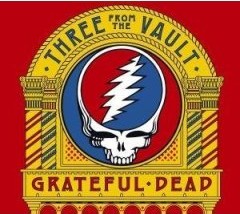
Grateful Dead
Three from the Vault
(Rhino)
First Appeared in The Music Box, August 2007, Volume 14, #8
Written by John Metzger
Thu August 9, 2007, 06:00 AM CDT

Three from the Vault has been a long time coming. Hand-selected by Dan Healy to be the third installment in the Grateful Dead’s inaugural series of archival recordings, the project was scuttled in favor of the lower cost, 36-volume Dick’s Picks anthology. By the time that the band resumed its waltz through the collection of multi-track tapes that it had amassed, its attention had turned to other eras. Fifteen years later, Three from the Vault finally is seeing the light of day, though the question remains: Why in the world was this particular concert deemed so important by Healy that it was targeted for release over so many other, better performances?
Recorded on February 19, 1971, the show that is featured in its entirety on Three from the Vault was the second of a lengthy, six-date engagement at the Capitol Theater in Port Chester, New York. Considering how many events were weighing upon the Grateful Dead at the time, speculation might lead many to believe that the concert’s selection was tied to its historical significance. For starters, Mickey Hart was in the midst of a complete breakdown. After performing on the previous night, he took an enormous amount of medication to ease his mind, which caused him to fall asleep for three days. He subsequently retreated to his California ranch, leaving Bill Kreutzmann as the group’s lone drummer until October 1974. As the music contained on Three from the Vault demonstrates quite clearly, Kreutzmann slipped admirably into the role, and the result was a leaner, meaner outfit.
In an unusual twist, the Grateful Dead also had agreed to participate in a scientific experiment that was designed to prove the existence of extra-sensory perception (ESP) by exploring the interaction between various states of consciousness. In essence, an image was projected on a screen, and the assembled audience was told to "send" the picture to a man who was sleeping in a Dream Laboratory in Brooklyn. The results of these trials were conclusive enough to be published in a well-respected psychology journal.
On a more musical note, it was during the Port Chester gigs in 1971 that the tenuous songwriting partnership between Robert Hunter and Bob Weir dissolved, and, with the return of old chum John Barlow, a new relationship began to form. Of course, the Grateful Dead also was riding high in the wake of the success of its twin gems Workingman’s Dead and American Beauty, and it showed no signs of slowing down creatively. On February 19, nearly half of the songs that the group delivered — Loser, Bertha, Playing in the Band, Greatest Story Ever Told, Bird Song, Deal, Wharf Rat, and a cover of Chuck Berry’s Johnny B. Goode — had debuted in the previous 24 hours. In typical fashion, however, the material had not yet had time to ripen. Loser, Playing in the Band, and Bird Song showed a lot of potential, but they remained underdeveloped. Greatest Story Ever Told simply was a complete mess.
On the other hand, Johnny B. Goode may have been ragged, but the combination of Weir’s exuberant vocals, a driving rhythmic beat, and the tangled machinations of the guitars lent it a sense of urgency that was undeniable. The brisk pace of Bertha boasted a unique vocal twist that found Jerry Garcia’s phrasing settling somewhere between Bob Dylan and an old, soul singer, while Deal was a tight-knit fireball of country-tinged rock. The best of the new tunes was Wharf Rat, which pitted lovely ringing patterns from Weir against the clattering chord progressions supplied by Garcia. It wasn’t nearly as soothing as the Grateful Dead’s later renditions were, but the unsettling mood that was created was startlingly haunting.
None of these aspects — taken either alone or together — however, provide enough of a reason for this concert to have been selected for release on Three from the Vault, though here is a possible explanation: The show was meant to be a tribute to Janis Joplin. On October 4, 1970, the night that Joplin overdosed on heroin, the Grateful Dead was performing at Winterland in San Francisco. The group had learned of her death just prior to taking the stage, and Hart immediately had suggested that the ensemble dedicate its set to her. Garcia promptly rejected the idea, not wanting to place more of a pallor upon the evening than was necessary.
Despite the erratic behavior that she had exhibited while on stage with the band the previous summer, Joplin was close to the members of the Grateful Dead — and to Pigpen, in particular. On February 19, 1971, armed with a new tune that had been written in her honor (Bird Song), the ensemble took the stage of the Capitol Theater with the primary purpose of paying tribute to her memory. Nearly every song revolved around the notions of love and loss, and those that didn’t spread the idea that life goes on without the dearly departed. Although these themes were commonplace within the Grateful Dead’s repertoire, they were given irrefutable prominence on this particular night.
The aching blues of Elmore James’ Hurts Me Too, for example, gave way to the lonesome refrains of the traditional Dark Hollow. It all began to come into focus, however, during the anguished, mournful reading of Smokestack Lightning, on which the wailing cries that emanated from Pigpen’s harmonica melded with the razor-sharp peals that sprang from Garcia’s electric guitar. "Fare thee well," Pigpen sang quietly amidst the song’s winding cadence before somberly adding, "Little rider goin’ home...Can she hear me calling? Not too far away...I know she’s in the world somewhere." As if in answer to his pleas, the Grateful Dead jubilantly tumbled from China Cat Sunflower into I Know You Rider, thus providing a soothing salve while continuing to use images of trains and passengers to further its examination of life and death.
Later in the show, the Grateful Dead followed its reflective, impassioned
reading of Bird Song with a fiery rendition of Easy Wind. While
Pigpen sang of riders, women, and liquor — a loosely based, but nonetheless
adaptable evocation of Joplin — Garcia used his guitar to trace a serpentine
path around the tune’s chugging, train-like rhythm. The paisley blue-hued
patterns he conjured coaxed roughly 1,500 minds to follow him over the mountains
and into the deep crevasses of the music. Elsewhere, the intricate, cosmic
spirals and violent eruptions of That’s It for the Other One turned the
suite of movement and dance into a grim acceptance of loss, while Good Lovin’
concluded the concert with a rousing blast of life-affirming, Otis
Redding-inspired soul. It’s impossible, of course, to get inside the minds of
the members of the Grateful Dead and know with any certainty what they were
thinking. Nevertheless, when its performance is viewed from this perspective,
all the botched lyrics and embryonic journeys melt away, and Three from the
Vault assumes an air of greater importance than it typically has been
granted.  ½
½
Three from the Vault is available
from Barnes & Noble. To order, Click Here!
Ratings
1 Star: Pitiful
2 Stars: Listenable
3 Stars: Respectable
4 Stars: Excellent
5 Stars: Can't Live Without It!!
Copyright © 2007 The Music Box