








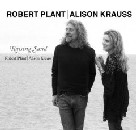
Robert Plant / Alison Krauss
Raising Sand
(Rounder)
John Metzger's #1 album for 2007
Killing the Blues: Memorable Song #3 for 2007
First Appeared in The Music Box, October 2007, Volume 14, #10
Written by John Metzger
Tue October 23, 2007, 06:40 AM CDT

Raising Sand is not an easy album to embrace, yet its hypnotic allure is utterly impossible to miss. Improbably, Robert Plant, Alison Krauss, and T Bone Burnett combined their talents to record the outing, and the intimate atmospheres that they created are simultaneously chilling and warm, terrifying and lovely, haunting and sensual. Plant’s followers likely will bemoan the fact that the arrangements lack the thunderous, hell-raising fury of Led Zeppelin, while those in Krauss’ camp undoubtedly will complain that the bluegrass and pop textures for which she is known are barely recognizable. Only Burnett’s fans, particularly those of his work on Sam Phillips’ A Boot and a Shoe and his own The True False Identity, will find the air of familiarity that is necessary for grasping the set expediently.
In a sense, Raising Sand is Burnett’s baby, and he did a magnificent job finding the right songs and sculpting the perfect arrangements for Plant and Krauss to perform. Over the course of the past 15 years, Plant has evolved into a stronger singer than anyone has ever given him credit for being, and throughout Raising Sand — which builds considerably upon his work on Dreamland — he gives a gloriously inspired performance that stands as a finely crafted show of forceful restraint. Krauss, too, exceeds all expectations, bending her fiddle lines into aching cries, her voice into a ghostly whisper. Together, they make a perfect match. Inspired, perhaps, by the union of Isobel Campbell and Mark Lanegan on Ballad of the Broken Seas, Plant and Krauss use their reputations to their advantage, pitting light against dark, innocence against experience, delicateness against grit.
Undeniably, Raising Sand is neither Houses of the Holy nor the O Brother, Where Art Thou? soundtrack. Yet, the constructs of both approaches can be heard creaking through its twisted contours. Burnett essentially took what he needed from the backgrounds of Plant and Krauss, and he allowed their individual histories to commingle and shade the endeavor. Within their interpretation of Gene Clark’s Polly Come Home, there are echoes of Led Zeppelin’s mystical folk-rock as well as the rendition of Morning Dew that Plant had lent to Dreamland. Krauss, meanwhile, leans on her country roots, but upends the sexuality of Through the Morning, Through the Night, another Clark-penned tune. Elsewhere, Killing the Blues, with its hushed harmonies and gentle washes of pedal steel, is a portrait of autumnal beauty; Sam Phillips’ Sister Rosetta Goes Before Us is delivered as a moody hallucination that comes in the wake of crushing heartache; and there’s a flame that flickers deep within the death-stalked refrains of Rosa Lee Watson’s Your Long Journey.
From Raising Sand’s tightly knit harmonies to its contents, The Everly Brothers also served as a major source of inspiration to Burnett, Krauss, and Plant. No less than four of its tracks — Li’l Millet & His Creoles’ Rich Woman, Allen Toussaint’s Fortune Teller, Mel Tillis’ Stick with Me Baby, and Phil and Don Everly’s own Gone Gone Gone (Done Me Wrong) — are directly influenced by the siblings’ recordings, and their spirit is never far removed from the rest of Raising Sand either. Strange as it may seem, this actually makes perfect sense, considering not only that Plant’s former band-mate Jimmy Page reportedly contributed guitar to The Everly Brothers’ 1966 foray Two Yanks in England, but also that the combination of hillbilly fare and rock ’n‘ roll that the Everlys employed is what lies at the heart of Burnett, Krauss, and Plant’s game plan.
Ultimately, though, Raising Sand sketches the place where the old,
weird America collides with the new, weirder America. The physical and digital
highways that have been laid over the course of the last century may have made
the country — and the world — a smaller place, but the distances that once
separated the inhabitants of rural communities still resonate through the
detached and disconnected strands of modern society. In making Raising Sand,
Burnett, Plant, and Krauss dared to imagine what Bob Dylan’s The Basement
Tapes and The Band’s Music from Big Pink would have sounded like if
they had been recorded not in anticipation of the apocalypse but rather in its
aftermath. Consequently, Raising Sand is as spooky as it is soothing; it
is as beautiful as it is unnerving. 
50th Annual Grammy Award Winner:
Best Pop Collaboration with Vocals
Gone Gone Gone (Done Moved On)
51st Annual Grammy Award Winner:
Record of the Year
Please Read the Letter
51st Annual Grammy Award Winner:
Album of the Year
51st Annual Grammy Award Winner:
Best Pop Collaboration with Vocals
Rich Woman
51st Annual Grammy Award Winner:
Best Country Collaboration with Vocals
Killing the Blues
51st Annual Grammy Award Winner:
Best Contemporary Folk/Americana Album
Of Further Interest...
Leonard Cohen - Live at the Isle of Wight 1970
John Fogerty - The Blue Ridge Rangers Rides Again
Mark Knopfler / Emmylou Harris - Real Live Roadrunning
Raising Sand is available from
Barnes & Noble. To order, Click Here!
Ratings
1 Star: Pitiful
2 Stars: Listenable
3 Stars: Respectable
4 Stars: Excellent
5 Stars: Can't Live Without It!!
Copyright © 2007 The Music Box