








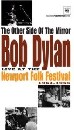
Bob Dylan
The Other Side of the Mirror: Live at the Newport Folk Festival, 1963–1965
(Legacy)
#2 Boxed Set/Live Album/Music DVD for 2007
First Appeared in The Music Box, October 2007, Volume 14, #10
Written by Douglas Heselgrave
Mon October 29, 2007, 06:40 AM CDT

It has taken 42 years for Columbia Records to release a complete version of what has to be one of the most controversial and subsequently mythologized live performances in the history of popular music. Though the show has been bootlegged endlessly and portions of it were included in Martin Scorsese’s brilliant 2005 documentary No Direction Home, it is only now that a complete audiovisual record of Bob Dylan’s transformation at the 1965 Newport Folk Festival has been made available for widespread public assessment.
Currently, Bob Dylan is enjoying a renaissance of attention and critical acclaim that he has not experienced for many years. His fan base exited en masse after he became a born-again Christian in 1979, and he spent much of the 1980s and early 1990s in relative obscurity. Although he issued a handful of underappreciated albums, he often was portrayed in the press as a cantankerous and unintelligible has-been whose glory days were well behind him. Nevertheless, backed by an amazing and ever-changing band, he continued to tour relentlessly, singing and playing night after night with a verve and intensity that many musicians half his age couldn’t possibly duplicate. Now, after releasing three very strong collections (Time Out of Mind, Love and Theft, and Modern Times), it is clear that Dylan has worked hard to reestablish his place in the contemporary spotlight. Given this renewed interest in his art, there has been a corresponding flood of reissues, live sets, and DVDs offered for sale to the public. As interesting as some of these collections have been, none is nearly as significant or as revealing as The Other Side of the Mirror: Live at the Newport Folk Festival, 1963–1965.
By presenting Dylan’s complete evening and workshop stage appearances at the Newport Festival between 1963 and 1965, The Other Side of the Mirror highlights the early trajectory of his artistic development, and it presents it in a way that requires no analysis or interpretation. The songs and the manner in which he plays them speak for themselves. Director Murray Lerner’s decision to offer the footage without any critical explication is a brilliant one. So much has been written about these performances that any record of them risks the danger of being weighed down by its own perceived significance. There are no voice-overs from Dylan experts or social historians to mar the proceedings. The visuals and music tell the story perfectly without any unnecessary intervention.
Watching The Other Side of the Mirror, the viewer first encounters a 22-year-old Dylan as he somewhat awkwardly ascends the stage of the Newport Folk Festival in 1963, where he took the folk music world by storm. Looking impossibly young and inexperienced, the world-weary Dylan of later years is nowhere in evidence. He laughs and jokes with the crowd as well as with his fellow musicians, and he obviously is delighted to have been given the opportunity to share his songs with a large and appreciative audience. Though his guitar playing is rudimentary and his instrument often is out of tune, the young singer displays a charisma and talent that, even at this early date, place him head-and-shoulders above the nearest of his peers. His 1963 performances of classics like North Country Blues and Who Killed Davey Moore? — with luminaries such as Doc Watson, Clarence Ashley, and Judy Collins listening incredulously as they wait to perform their own songs — reveal a musical prodigy whose talent was literally exploding and expanding before his audience’s eyes and ears. Blowin’ in the Wind — the festival’s closing number, which featured Dylan, Joan Baez, and Peter, Paul, and Mary as well as the Freedom Singers and Pete Seeger — leaves no doubt in anyone’s mind that Dylan was a major musical and cultural force.
By 1964, the work-shirt-wearing poet of the proletariat’s musical palette had expanded considerably. Eloquent Guthrie-esque homilies to the downtrodden had given way to a more literary, less structured free-form type of verse that incorporated more personal and less social subject matter. Though his work still was supported by his own considerably improved guitar playing — which gave the illusion that it remained embedded within the folk tradition — Dylan’s music now owed as much to Allen Ginsberg and Lawrence Ferlinghetti as it did to Studs Terkel and The Weavers. The nighttime performance of Chimes of Freedom, which concludes the 1964 segment of The Other Side of the Mirror, shows just how far his art had developed in a single year. This confident, daring and complex rendition of this then-new tune demonstrates, more than anything else, how Dylan clearly was leaving all of his contemporaries in the dust without even trying. He did not reject folk music as such — even his most recent recordings still demonstrate the reverence with which he holds traditional American song forms. Rather, his 1964 appearance at Newport asserts that his own muse was not one that would tolerate any restrictions or dogmatic ideas of what constituted a composition that was worthy of being heard.
Moving to 1965, it is clear that something had changed again. For starters, the audience looks different. Long-haired young men and women in embryonic hippie fashions sat alongside work-booted social theorists as Dylan performed yet another slate of new songs. Even more than in 1964, his acoustic, daytime performances of If You Gotta Go, Go Now and Love Minus Zero/No Limit were an indication of his new musical and philosophical directions. His change in approach had less and less to do with the ethos of traditional folk and more to do with the restless searching of the coming-of-age baby-boomers. Of course, much has been written about this uneasy coexistence.
Watching these performances on The Other Side of the Mirror 42 years later, it is often hard to come to grips with and identify what was so controversial about Dylan’s appearance at the 1965 festival. With the distance of time, Dylan no longer comes off as a heretic. Rather, he seems to be working in the tradition of many great artists — from Van Gogh to Beethoven — who have rejected the strictures of their chosen form in order to explore new possibilities within it. Today, when viewed in the context of history, there is nothing particularly shocking about Dylan’s stylistic transformation. After all, bands from Muddy Waters to The Animals to Paul Butterfield already were playing traditional songs in an electric setting.
The controversies arising from Dylan’s set are not evident in the concert itself. If anything, the discomfort that arises from watching Dylan, as he performs his songs with an electric band, has to do with how unpolished and under-rehearsed he and the other musicians were. Given the rapturous reception that he had received during his first two performances at the Newport Folk Festival, he, perhaps, thought that this would be the best venue for trying out his new act. The audience, itself, didn’t seem particularly upset by his new approach, either, and maybe Dylan was not so much rejected by his fans as he was by his own, more narrow-minded peers.
The Other Side of the Mirror ends with a somewhat shaky and vulnerable Dylan coming out by himself, armed again only with his acoustic guitar. Yet, if his critics took this as an indication of a change of heart, they weren’t listening. His performance of It’s All Over Now, Baby Blue is one of the most eloquent kiss-offs in history, the echoes of which still resonate with a bitterness and commitment that have yet to be diminished by the passage of time.
Of course, the intervening years have proven Dylan’s instincts to have been
correct, and — from Bringing It All Back Home to Blonde on Blonde
to John Wesley Harding — the albums that he issued immediately after the
Newport debacle remain among the best in his whole oeuvre. As much as it is a
record of his artistic growth, The Other Side of the Mirror, also is a
metaphorical exploration of the nature of change. The Bob Dylan that came out of
Newport may never have had the desire to glance over his shoulder and see what
he may have lost or gained along the way. For the rest of us, it is a
fascinating look back. The Other Side of the Mirror is a film about which
fans and scholars alike will watch, discuss, and argue for many years to come. 
Of Further Interest...
Isobel Campbell / Mark Lanegan - Hawk
Leonard Cohen - Live at the Isle of Wight 1970
Bob Dylan - Together through Life
The Other Side of the Mirror: Live at the Newport Folk
Festival, 1963–1965 is available from Barnes & Noble.
To order, Click Here!
Ratings
1 Star: Pitiful
2 Stars: Listenable
3 Stars: Respectable
4 Stars: Excellent
5 Stars: Can't Live Without It!!
Copyright © 2007 The Music Box